
A LIVING HISTORY AND ENGINEERING MARVEL: THE TOY TRAIN IN DARJEELING

The Darjeeling Himalayan Railway (DHR), affectionately known as the Toy Train, offers a singular experience, seamlessly blending spectacular Victorian engineering, the living history of the British Raj, and some of the most breathtaking mountain scenery the Himalayas have to offer.
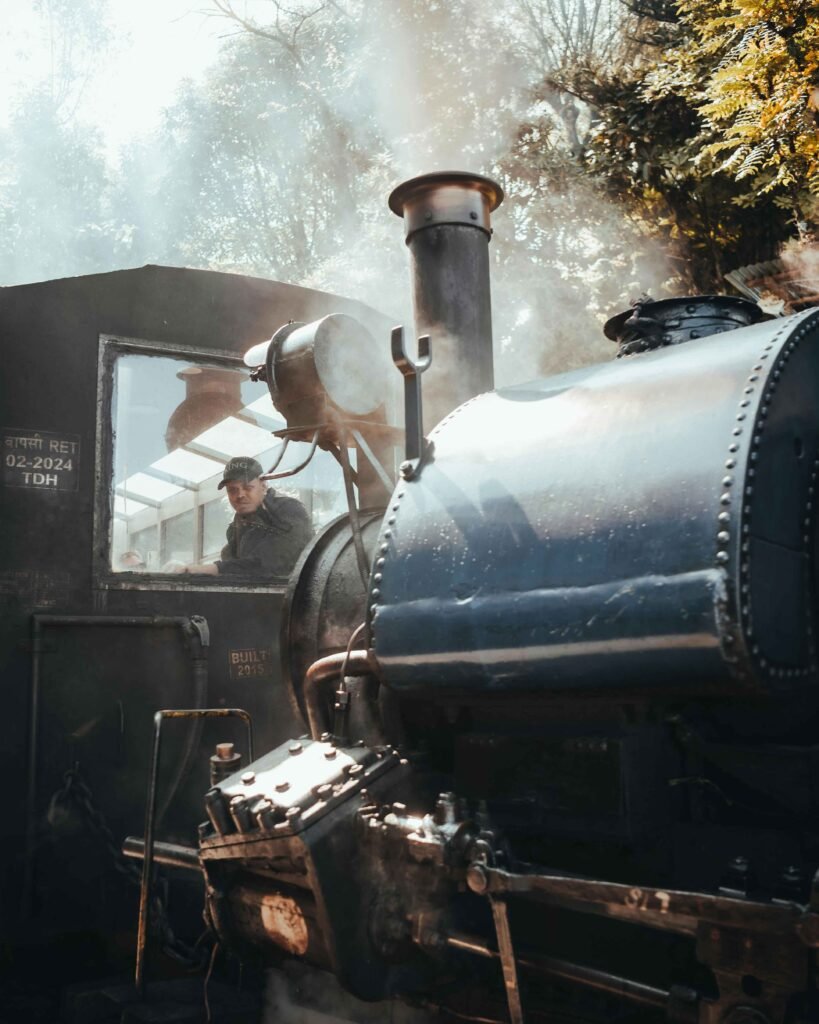
It is a mandatory stop for any visitor seeking both nostalgia and natural spectacle.
As a UNESCO World Heritage Site, recognized globally as an outstanding example of a hill passenger railway, it still retains its original features and operational practices from the late 19th century. This continuity provides a tangible link to the colonial era and ensures an authentic scenic journey.
The creation of the DHR was driven by the commercial viability of Darjeeling’s tea trade and the strategic need for better transport and accessibility within the British Raj in the late 1870s.
THE ENGINEERING MARVEL
The Darjeeling Himalayan Railway is celebrated worldwide as an extraordinary feat of Victorian engineering, designed to conquer an impossible climb of over 2,100 meters (from ≈100 m at New Jalpaiguri to ≈2,200 m at Darjeeling). It uses unique and ingenious solutions to tackle the steep gradients, showcasing human ingenuity against nature.
- Loops (like Batasia Loop): To gain elevation in confined spaces, the engineers devised the spiral track. The most famous, the Batasia Loop , allows the train to circle back on itself, gaining height rapidly while simultaneously offering a breathtaking 360-degree panoramic view of the surrounding valleys and the Kanchenjunga range.
- “Z” Reverses (Zig-Zags): These sections are used where the slopes are too steep for even the loops. The train runs forward, stops, reverses backward on a new track, and then proceeds forward again on a third track to effectively “zig-zag” up the unmanageable gradients.
The slow, chugging pace of the steam-hauled “Joy Rides” is a must-do when in Darjeeling. The train runs so close to the road and local life that it feels completely integrated into the Himalayan foothills.